
In This Article
An oil-free air fryer for low-fat cooking is a compact countertop convection oven that blasts hot air around food with a fan, crisping the surface using little or no added oil. Compared with deep frying, it cuts fat and calories sharply while keeping a satisfying crunch, which makes lighter everyday meals realistic.

Here’s the plain-English version. An air fryer is a small convection oven with a powerful fan, and the name is marketing sugar. Nothing is actually fried. Hot air strips moisture from the surface of your food, and that dried surface browns and crunches. The oil does a little work, but far less than a bubbling vat of it.
Now for the honest bit. “Oil-free” is a spectrum, not a switch. Chicken thighs with skin, bacon, and sausages crisp up on their own fat. Potatoes, vegetables, and breaded items want a whisper of oil, usually a mist rather than a pour. That whisper is still a world away from the multiple cups a deep fryer swallows.
So which machine does this best? I compared seven real, widely sold models across budget, mid-range, and premium tiers, drawing on published editorial testing, lab-style scores, and the patterns that show up again and again in owner reviews. I haven’t handled these units myself, so everything below is analysis built on real specs and real, aggregated feedback. I’ll flag where evidence runs thin.
Quick Comparison: 7 Oil-Free Air Fryers at a Glance
| Product | Capacity | Style | Best For |
|---|---|---|---|
| Ninja AF101 | 4 qt | Single basket | Solo cooks and couples |
| Cosori Pro LE 5-Qt | 5 qt | Single basket | Small families on a budget |
| Ninja Max XL AF161 | 5.5 qt | Single basket | Fast, hot, crunchy results |
| Instant Vortex Plus 6-Qt | 6 qt | Single basket with window | Families who like to watch |
| Philips 3000 Series | About 6.2-7.2 L (model dependent) | Single basket with window | Even browning, premium feel |
| Ninja Foodi DZ201 | 8 qt (two 4 qt baskets) | Dual basket | Full meals, two foods at once |
| Chefman TurboFry Touch 8-Qt | 8 qt | Single basket | Big batches on a tight budget |
Looking at the table, capacity is the first fork in the road. The Ninja AF101 and Cosori Pro LE 5-Qt suit one to four eaters, while the Ninja Foodi DZ201 and Chefman TurboFry Touch 8-Qt are built for crowds. The Philips 3000 Series and Instant Vortex Plus 6-Qt sit in the middle, and their windows let you check browning without opening the basket and dumping heat.
💬 Just one click — help others make better buying decisions too!😊
Top 7 Oil-Free Air Fryers for Low-Fat Cooking: Expert Analysis
Every pick below gets the same treatment: what the spec means in practice, who should care, what reviewers keep saying, and whether the price range earns it. Prices are ranges at the time of research and may vary, so check current pricing before you buy.
1. Ninja AF101 — compact, quick, and kind to small kitchens
The Ninja AF101 is small in all the right ways. It’s a 4-quart, 1550-watt single-basket machine with a ceramic-coated nonstick basket that fits a studio counter without a negotiation. That wattage matters: strong heat means quick preheating and fast recovery, so food spends less time steaming in its own moisture, which is the real enemy of crisping without oil.
The catch is the floor space inside. RTINGS measured a basket surface area of roughly 50 square inches, so a pound of wings per batch is the realistic ceiling. Based on the spec comparison, this is a one-or-two-person machine, and a good one.
Reviewers consistently describe it as quiet and well sized for couples, and testers note it cooks quickly but isn’t meant for groups.
Pros:
- ✅ Fast preheat and quick cooking
- ✅ Ceramic nonstick basket cleans up easily
- ✅ Small footprint for tight kitchens
Cons:
- ❌ Limited cooking surface per batch
- ❌ Tops out at 400°F
Price range: roughly $70-$100. Verdict: excellent value if you cook for one or two.

2. Cosori Pro LE 5-Qt — sleek 450°F workhorse for small families
The Cosori Pro LE 5-Qt (model CAF-L501-KUS) pairs a 1500W heater with a 450°F ceiling, and that top temperature is what lets a thin film of oil do a thick job. A hotter surface sets the crust before the interior dries out.
Here’s what the spec sheet won’t tell you, but editorial testers do. Homes & Gardens found the default presets lean toward overcooking, with veggies emerging as its strongest suit and nuggets and fries disappointing on the stock settings. TechRadar, by contrast, praised its crisp fries and sleek, quiet design. My read: treat the presets as a starting point, then trim time or temperature by a notch.
Owners widely call it a strong everyday pick for two to four people.
Pros:
- ✅ High 450°F ceiling for aggressive crisping
- ✅ Quiet, compact, and good-looking
- ✅ Handles vegetables especially well
Cons:
- ❌ Stock presets can overcook food
- ❌ Too small for big family batches
Price range: around $80-$100. Verdict: probably the best value-per-feature in this lineup.
3. Ninja Max XL AF161 — hottest, fastest single-basket crunch
The Ninja Max XL AF161 is the speed demon here. Its 1750W heater, 450°F “Max Crisp” mode, and 105-450°F range made it a high scorer in RTINGS’ testing for cooking speed and air frying. The 5.5-quart ceramic basket is advertised to hold about 3 pounds of fries or wings.
What does that mean for low-fat cooking? A faster cook means less time in the heat, and that’s the easiest way to keep chicken juicy without leaning on oil for moisture. Two caveats from the same testers: it runs hot, and the cooking surface is small for its stated capacity, so overloading it dulls the crunch.
Retailer ratings across several big chains sit in the mid-4-star range, and owners often mention it holding up for years.
Pros:
- ✅ Very fast preheat and cooking
- ✅ Dehydrate and broil modes add range
- ✅ Dishwasher-safe basket and plate
Cons:
- ❌ Runs hot, so watch delicate foods
- ❌ Small surface area for its capacity
Price range: roughly $110-$180. Verdict: worth it for speed-focused cooks.
4. Instant Vortex Plus 6-Qt — roomy, versatile, window-equipped
The Instant Vortex Plus 6-Qt offers a 6-quart single basket with six programs (air fry, roast, bake, broil, reheat, dehydrate). The ClearCook variant adds a window, which is more useful than it sounds: you can pull food at the golden-brown moment instead of guessing.
Instant says the basket fits about 2 pounds of fries or 4 pounds of chicken, a claim worth treating as an upper bound. TechRadar liked its versatility but flagged a bulky build that eats counter space. Reviewed found it crisps well and its window works nicely, though its odor-erasing feature was only so-so.
Real Homes singled it out as a strong option for homemade fries, with a sturdy stainless feel.
Pros:
- ✅ Generous 6-quart basket
- ✅ Window variant helps prevent over-browning
- ✅ Dishwasher-safe, nonstick basket
Cons:
- ❌ Bulky on small counters
- ❌ Odor filter underwhelmed some testers
Price range: around $120-$170. Verdict: a solid mid-range family pick.
5. Philips 3000 Series — the most even browning of the group
The Philips 3000 Series is the premium single-basket pick, built around RapidAir Plus airflow. Tom’s Guide’s reviewer called it the most even cooking they’d experienced in an air fryer, which is exactly what low-fat cooking rewards. Even airflow means no pale patches begging for extra oil.
You also get a see-through window, a touchscreen, 12 presets, and a 140-400°F range. The trade-offs are real: it’s bulky (about 13 pounds), tops out at 400°F, and costs more than Philips’ own 2000 Series. Model numbers and capacities vary by region (6.2 L and 7.2 L versions both exist), so confirm the exact model before ordering.
Pros:
- ✅ Standout even, consistent browning
- ✅ Window and touchscreen controls
- ✅ Premium, easy-to-clean design
Cons:
- ❌ Pricey compared with similar capacity
- ❌ Lower 400°F maximum temperature
Price range: roughly $140-$180. Verdict: pay up only if evenness matters most.
6. Ninja Foodi DZ201 — two baskets, two foods, one finish time
The Ninja Foodi DZ201 splits 8 quarts into two independent 4-quart baskets. With Match Cook you can mirror settings for a full-capacity batch, and Smart Finish syncs different foods so they land hot at the same moment. That’s a quietly healthy feature: salmon and broccoli done together beat chicken nuggets “because it was faster.”
RTINGS rated its air frying well and called it suited to groups of five or more. It also judged the DZ201 a better option than the Philips 3000 Series dual-basket model, mainly because it cooks much faster. Retailer ratings for it run high across thousands of reviews.
The downside is plain: it’s large and means two baskets to wash.
Pros:
- ✅ Independent zones cook two foods at once
- ✅ Smart Finish syncs completion times
- ✅ Fast results for big households
Cons:
- ❌ Large footprint on the counter
- ❌ Each basket is only 4 quarts
Price range: roughly $120-$200. Verdict: the best choice for full-meal cooking.
7. Chefman TurboFry Touch 8-Qt — the budget route to big batches
The Chefman TurboFry Touch 8-Qt is the capacity-per-dollar play. It’s an 8-quart single basket with digital presets, a viewing-window version, an optional basket divider on some configurations, and a “Hi-Fry” boost that retailers list at up to 450°F.
I’ll be upfront: I couldn’t find independent lab-style testing of this exact model, so this rests on retailer ratings and owner themes. Those ratings generally land between about 4.2 and 4.5 stars across large review pools, and a review aggregator gave it an A grade on a smaller pool. One owner tip worth stealing: spray oil on the food, not the unit.
Pros:
- ✅ Huge 8-quart capacity for the money
- ✅ Window version for easy monitoring
- ✅ Hi-Fry boost for finishing crunch
Cons:
- ❌ Little independent lab testing available
- ❌ Bulky for small kitchens
Price range: around $60-$120 depending on configuration. Verdict: strong value if you cook for a crowd.
How to Choose an Oil-Free Air Fryer for Low-Fat Cooking
Choosing well comes down to six decisions. Here’s the order I’d tackle them in.
- Match capacity to your household. RTINGS notes a 5.5-quart unit serves about three to four people, so use that as your yardstick.
- Check the cooking surface, not just quarts. Crisp needs single layers. RTINGS measured roughly 50 square inches on the 4-quart Ninja AF101 versus about 62 on a larger Ninja, so quarts alone mislead.
- Look at maximum temperature and preheat behavior. Higher heat sets a crust faster, which means you can use less oil.
- Prioritize nonstick, dishwasher-safe parts. If cleanup is a chore, the machine becomes a shelf ornament.
- Decide between single and dual baskets. Dual units shine for full meals; single baskets are simpler and cheaper.
- Be honest about footprint and noise. Windows, big baskets, and dual drawers all demand space.
| Product | Standout Feature | Price Range | Best For |
|---|---|---|---|
| Ninja AF101 | Compact, fast preheat | $70-$100 | Singles and couples |
| Cosori Pro LE 5-Qt | 450°F ceiling, quiet | $80-$100 | Small families |
| Ninja Max XL AF161 | Max Crisp speed | $110-$180 | Speed-first cooks |
| Instant Vortex Plus 6-Qt | ClearCook window | $120-$170 | Mid-size families |
| Philips 3000 Series | Even RapidAir Plus browning | $140-$180 | Quality-first buyers |
| Ninja Foodi DZ201 | Dual independent baskets | $120-$200 | Full meals, big households |
| Chefman TurboFry Touch 8-Qt | 8 qt capacity for the price | $60-$120 | Budget batch cooks |
The table shows how little the budget tier gives up: the Cosori Pro LE 5-Qt matches the pricier models on top temperature. If your budget is tight, the Chefman TurboFry Touch 8-Qt buys the most space, while the Philips 3000 Series is the one to choose purely for evenness. Between them, the Ninja Foodi DZ201 is the best match for households cooking several things at once.

Rapid Air Circulation: The Engine Behind the Crunch
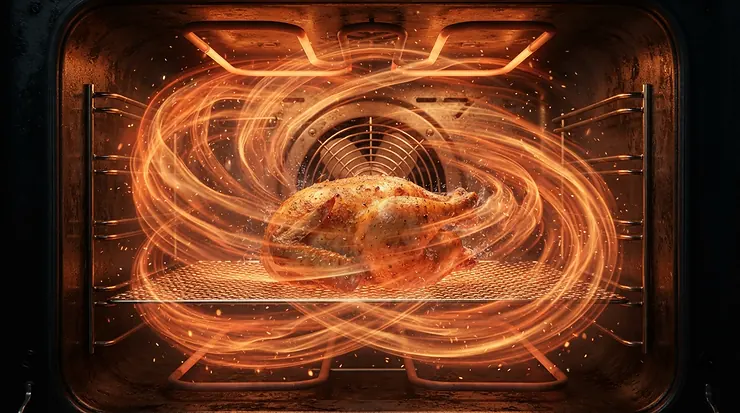
Rapid air circulation is the whole trick. A fan pushes superheated air past every surface of the food, and a perforated basket or crisper plate lets it flow underneath too. Wikipedia’s convection oven entry describes the same principle, with circulating air carrying heat to food faster than still air does.
Why does this matter for a low-fat result? Moving air whisks away the thin layer of steam that clings to wet food, and that layer is what keeps things soggy. Without it, the surface dries, browns, and crunches with only a trace of oil.
What this means in practice:
- Don’t overcrowd. Packed food blocks the airflow and steams instead of crisping, which is why RTINGS’ surface-area numbers matter.
- Shake or flip halfway. It exposes new surfaces to the airflow.
- Prefer wide over deep. A broad single layer beats a tall pile every time.
The Philips 3000 Series is built around this idea, and reviewer comments on its evenness show why airflow design matters. The Ninja Max XL AF161 takes the brute-force route with more heat and power.
✨ Don’t Miss These Exclusive Deals!
🔍 Take your oil-free air fryer for low-fat cooking to the next level with these carefully selected products. Click on any highlighted item to check current pricing and availability. These tools will help you create crisp, lighter meals your family will love!
Fat Reduction: What You Actually Save (and What You Don’t)
Fat reduction is the headline benefit, and it’s real. Brands often advertise up to 75% less fat than traditional frying, and Healthline notes that figure is a manufacturer claim. The mechanism is simple: deep frying submerges food in oil it then absorbs, while an air fryer uses roughly a tablespoon or less, per Medical News Today. The Cleveland Clinic frames air frying as a way to cut fat without sacrificing flavor and texture.
Some arithmetic helps. A tablespoon of oil carries roughly 120 calories, so skipping a deep-fry bath is a big swing, while skipping that last teaspoon of oil is a small one.
Where the savings shrink:
- Versus roasting. Roasting already uses modest oil, so the gap narrows.
- With pre-fried frozen foods. Those products already contain oil, so you’re reheating fat, not removing it.
- When coatings add up. Heavy breading, cheese, and sugary sauces can quietly cancel the gain.
The cleanest wins come from swapping deep-fried favorites, such as fries, wings, and cutlets, for air-fried versions.
Low Oil Air Fryer for Heart Healthy Meals: What the Evidence Says
A low oil air fryer for heart healthy meals works because it removes the most obvious problem, the deep-fry bath, while letting you choose better fats. A Mayo Clinic community health piece reminds readers that even healthy oils add calories quickly, so a spritz or drizzle goes a long way.
Registered dietitians quoted by The Healthy add an important twist: the heart benefits depend on the ingredients, not just the method. Dropping all oil isn’t automatically healthier, since olive and avocado oil can be heart-friendly in small amounts.
A practical heart-smart routine looks like this:
- Choose skinless chicken, fish, and non-starchy vegetables as your base.
- Use a refillable mister with olive or avocado oil instead of pouring.
- Read sodium on frozen breaded foods, which are often the weak link.
- Season with herbs, citrus, garlic, and spices rather than salty sauces.
This is general information, not medical advice. If you manage a heart condition or cholesterol, check with your clinician or dietitian. For this purpose I’d lean toward the Philips 3000 Series or Instant Vortex Plus 6-Qt for their windows and consistent results.
Air Fryer for Cutting Fat Without Losing Crunch: The Practical Guide
An air fryer for cutting fat without losing crunch rewards technique more than hardware. Here’s the routine I’d follow, whichever model you own.
Setup and first use. Wash the basket and plate per the manual, and place the unit with breathing room around its vents.
The five-step crunch method:
- Dry thoroughly. Pat food with a towel, because surface water is crunch’s enemy.
- Coat lightly. Toss with roughly a teaspoon to a tablespoon of oil per pound, depending on the food, and start low.
- Preheat if your model recommends it. The Cosori Pro LE 5-Qt includes a preheat preset for this reason.
- Cook in a single layer. Work in batches if needed.
- Shake midway and finish hot. A final burst at high heat sets the crust.
Maintenance schedule. Wash the basket after each use, wipe the heating area weekly, and replace scratched nonstick parts.
Common first-30-day mistakes: trusting presets blindly, overfilling the basket, and soaking food in oil “just to be safe.”
Crisping Without Oil: Tricks That Work (and One That Doesn’t)
Crisping without oil is possible, within limits. Foods with their own fat do it best: skin-on chicken, bacon, sausages, and meatballs release enough to brown themselves.
Problem → solution, step by step:
- Problem: pale, soft vegetables. Solution: a light mist plus a hot finish. The Ninja Max XL AF161 and Cosori Pro LE 5-Qt both reach 450°F for this.
- Problem: soggy fries. Solution: cut uniform sizes, dry well, and don’t crowd the basket.
- Problem: limp wings. Solution: pat dry and dust lightly with baking powder, a popular home trick, though I haven’t seen formal testing of it.
- Problem: breaded foods that look dry. Solution: use panko and a quick mist on the coating itself.
The thing that doesn’t work? Wet batter. It drips through the basket instead of setting, so stick to dry coatings.

Real-World Scenarios: Which Air Fryer Fits Your Life?
Scenario 1: The solo city cook. You cook five nights a week in a small apartment with limited counter space and a modest budget. The Ninja AF101 or Cosori Pro LE 5-Qt fits: compact, fast, and enough for one to two portions.
Scenario 2: The heart-conscious family of four. You want lighter dinners most nights, and you’d rather watch browning than guess. The Instant Vortex Plus 6-Qt or Philips 3000 Series suits you, since windows and even heat help you hit golden without extra oil.
Scenario 3: The weeknight host and meal prepper. You cook for five or six and want mains and sides finished together. The Ninja Foodi DZ201 is built for that, and the Chefman TurboFry Touch 8-Qt is the budget alternative if you can live with thinner independent testing.
In each case, buy for the household you actually have, not the one you imagine hosting at Thanksgiving.
Oil-Free Air Fryer vs Deep Frying and Oven Baking
| Method | Oil Needed | Crunch Level | Cleanup | Best For |
|---|---|---|---|---|
| Deep fryer | Several cups | Maximum | Messy | Occasional indulgence |
| Oven baking | Little to moderate | Moderate | Easy | Large batches |
| Pan frying | Moderate | Good | Moderate | Quick sears |
| Air fryer | About 1 tbsp or less | Very good | Easy | Everyday lighter meals |
The table makes the trade clear: an air fryer gets close to deep-fry crunch with a fraction of the oil. Ovens still win for sheer volume, so a big sheet pan of roasted vegetables may not need an air fryer at all. Even so, the air fryer’s speed and quick preheat make it the practical weeknight choice.
Long-Term Cost & Maintenance
Cost-per-use is where air fryers quietly shine. A machine in the $80-$100 range used four times a week for three years works out to roughly 600 cooks, which is pennies per meal. Some brands also claim energy savings versus a full-size oven, though treat those as marketing, not measurement.
To protect your investment:
- Hand wash or use the dishwasher-safe parts exactly as the manual says.
- Avoid metal utensils on ceramic or nonstick baskets.
- Many manufacturers advise against aerosol cooking sprays on nonstick surfaces, so check your manual and consider a refillable mister instead.
- Replace worn baskets rather than cooking on flaking coatings.
Dual-basket models like the Ninja Foodi DZ201 mean twice the baskets to maintain, while simple single-basket units like the Ninja AF101 are easier to keep pristine.
Acrylamide, Safety, and Smart Habits
Acrylamide deserves a calm look. According to the FDA, it forms from sugars and an amino acid naturally present in food, and the agency says you don’t need to stop eating fried, roasted, or baked foods. It encourages a healthy eating plan instead.
Air frying can lower acrylamide compared with deep frying, with one older study cited by Healthline reporting reductions of up to 90%. But starchy foods cooked at high heat can still form it, so air-fried potatoes aren’t a free pass.
Smart habits:
- Cook starchy foods to golden rather than dark brown.
- Keep vents clear and the unit on a heat-safe surface.
- Don’t overfill the basket, which affects both airflow and safety.
FAQ
❓ Can an oil-free air fryer really cook without any oil?
❓ What size air fryer do I need for a family of four?
❓ Is a dual-basket air fryer better for low-fat cooking?
❓ Do I need to preheat an air fryer?
❓ Are nonstick baskets safe for everyday use?
Conclusion
An oil-free air fryer for low-fat cooking won’t turn a pizza roll into kale, but it will make everyday favorites lighter, faster, and easier to clean. The best machine is the one that fits your household and your counter.
For most people, I’d start with the Cosori Pro LE 5-Qt for value, the Ninja Max XL AF161 for speed, and the Philips 3000 Series for evenness. Big households should look at the Ninja Foodi DZ201 or Chefman TurboFry Touch 8-Qt, while solo cooks will be happy with the Ninja AF101. Whatever you pick, pair it with sensible ingredients, a light hand on oil, and a single layer of food. Check current pricing before you buy, since prices change often.
✨ Ready to lighten up your dinners? Pick the air fryer that fits your kitchen and start crisping smarter today! 🍟🔥
Recommended for You
- Dual Basket Air Fryer for Families of Four: 7 Best Picks 2026
- Basket vs Glass Bowl Air Fryer: 7 Best Picks for 2026
- 7 Best Air Fryer With Preheat-Free Quick Start for Busy Mornings 2026
Disclaimer: This article contains affiliate links. As an Amazon Associate, I earn from qualifying purchases. If you purchase products through these links, we may earn a small commission at no additional cost to you.
✨ Found this helpful? Share it with your friends! 💬🤗
