
In This Article
It’s 6:52 a.m. The bus leaves at 7:20. Somewhere between finding one shoe and signing a permission slip, you also need to feed a human being. Every minute you spend waiting for an appliance to warm up is a minute stolen from something else.
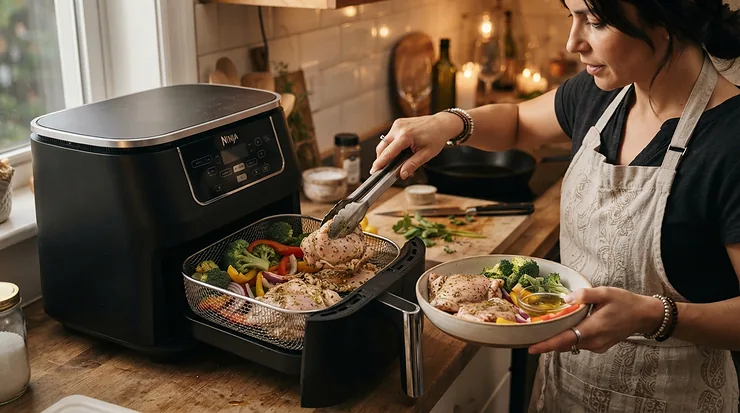
That is the entire pitch for an air fryer with preheat-free quick start for busy mornings: you drop the food in, press start, and the machine does the heavy lifting while you hunt for that shoe. No standing around. No “wait for the beep” ritual before you can even begin.
Here’s the honest wrinkle, though. “Preheat-free” rarely means the machine heats instantly. It means the appliance is built to get hot so fast, or to fold its warm-up into the cook cycle, that you skip the separate step. A Tom’s Guide expert roundup on air fryer preheating notes that most air fryers need roughly three to five minutes to preheat, and that Ninja models are designed to skip the step, with just an extra minute added to the cook time. That is the practical definition we’ll use all through this guide.
I couldn’t hand-test these machines, so you won’t find invented lab drama here. What you will find is real spec comparison, aggregated owner and roundup sentiment, and straight reasoning about what the numbers mean on a hectic Tuesday. We’ll cover seven real models, the heating element wattage that drives speed, realistic cook time per batch, whether a ready-to-cook indicator earns its screen space, and how a fast heating air fryer for weeknight dinners can pull double duty after sunrise. Prices below are ranges only, because they move constantly.
Quick Comparison: 7 Air Fryers at a Glance
| Air Fryer | Capacity | Wattage | Max Temp | Price Range | Best For |
|---|---|---|---|---|---|
| Ninja AF101 | 4 qt | 1550W | 400°F | Under $130 | Solo cooks and couples |
| Cosori Pro LE 5-Qt | 5 qt | 1500W | 450°F | Around $100 | Square-basket breakfasts |
| Instant Pot Vortex Plus 6-Qt | 6 qt | 1700W | 400°F | Around $120 | Family mornings |
| Ninja Air Fryer Pro 5-Qt | 5 qt | 1750W | 400°F | Mid-$100s | Fastest warm-up per dollar |
| Cosori TurboBlaze 6-Qt | 6 qt | 1725W | 450°F | Around $130 | Quiet, high-heat cooking |
| Ninja Foodi DualZone | 10 qt (two baskets) | 1690W | Varies by model | $150-$200 range | Two foods at once |
| Philips Premium Airfryer XXL | XXL | Check label | Varies | $250-$350 range | No-fuss premium cooking |
Read that table the way a shopper at a hardware store reads a tool: the wattage column tells you speed, the capacity column tells you how many mouths you can feed per round, and the “Best For” column tells you where each one shines. The Ninja Air Fryer Pro 5-Qt and Cosori TurboBlaze 6-Qt pack the most power into a household-friendly footprint, while the Ninja AF101 and Cosori Pro LE 5-Qt win on sheer affordability. The Ninja Foodi DualZone is the only one that cooks two different breakfasts at once, which is its own kind of time saver.
💬 Just one click — help others make better buying decisions too!😊
Top 7 Air Fryer With Preheat-Free Quick Start for Busy Mornings: Expert Analysis
1. Ninja AF101 — compact workhorse for solo mornings
The Ninja AF101 is the small-counter favorite, and its appeal starts with simplicity. It’s a 4-quart basket with 1550W of heating power, a 105°F to 400°F range, and a dishwasher-safe ceramic-coated basket.
What does that mean at 6:50 a.m.? A 1550W element in a 4-quart chamber has a small volume to heat, so the cavity gets hot quickly, and Ninja’s own approach, as the Tom’s Guide experts describe it, is to skip separate preheating and add a minute to the cook time. That’s a workable trade for toaster-waffle-and-sausage mornings.
Based on the spec comparison, this model suits one or two people. Four quarts handles roughly two portions of hash browns or a few strips of bacon per round, but a family of four will be running multiple batches. Roundups and owner ratings generally land around 4.6 to 4.7 stars, and reviewers frequently praise easy cleanup and a straightforward control layout. I couldn’t verify a deep review sample, so treat that as a rating-level signal rather than gospel.
Pros:
- ✅ Small footprint fits crowded counters
- ✅ Dishwasher-safe ceramic basket
- ✅ Simple controls, minimal learning curve
Cons:
- ❌ Four quarts means more batches for families
- ❌ 400°F ceiling is lower than some rivals
Expect a price in the under-$130 range. For a single cook, the value is excellent.
2. Cosori Pro LE 5-Qt — square basket for breakfast spreads
The Cosori Pro LE 5-Qt wins you over with geometry. Its square basket gives more usable flat surface than a round one of similar volume, which matters when you’re laying out sausage links or a row of toaster pastries in a single layer.
The specs: 1500W, up to 450°F, a ceramic-coated basket, and preset programs including a shake reminder. That 450°F ceiling is the sleeper feature for mornings. Higher max temperature means you can blast frozen breakfast items for a short, crisp finish rather than a long, patient one.
Honest analytical take: with 1500W, this machine is slightly less powerful than the Ninja Pro class, so I’d treat it as a “fast, not fastest” option. But the square layout lets you cook more food per round, so your total time to a finished plate can still beat a rounder 5-quart design. Roundups list owner ratings around 4.7 stars, with commentary leaning toward value and ease of use.
If your mornings involve a few distinct items, such as bacon, then toast, then reheated leftovers, the presets and the shake reminder reduce the “did I do that?” fog. Pair it with the dehydrate-free simplicity you’d actually use on a school morning, and it’s a smart daily driver.
Pros:
- ✅ Square basket maximizes single-layer space
- ✅ 450°F max for quick crisping
- ✅ Shake reminder prevents uneven batches
Cons:
- ❌ 1500W is modest next to Ninja Pro models
- ❌ Preset menu can feel overbuilt for toast-and-eggs users
Price lands around $100. Verdict: superb value for small families.
3. Instant Pot Vortex Plus 6-Qt — roomiest for family breakfasts
The Instant Pot Vortex Plus 6-Qt is the one you buy when mornings involve more than two people. It’s a 6-quart basket, 1700W, 400°F max, with touch controls and a footprint of roughly 12.4 by 14.9 inches.
That footprint is the honest cost. Roundup comparisons note it eats counter width at nearly 15 inches, which matters in a tight kitchen. In return, you get capacity for a real family batch: a full tray of hash brown patties or a pound-plus of bacon in a looser pile.
At 1700W, the heating element wattage is in the upper-middle tier, so the cavity should warm briskly despite the larger volume. What the spec sheet won’t tell you, but roundups hint at, is that large baskets need a gentler hand with overcrowding. Stuff it to the brim and your “time saved” evaporates in uneven results.
User ratings in roundups hover around 4.6 stars, and a viewing window shows up in some versions of the Vortex line, which lets you check browning without opening the basket and losing heat. Whether yours has it depends on the exact model, so verify before you buy.
Pros:
- ✅ Six quarts handles four-person batches
- ✅ 1700W gives brisk warm-up for its size
- ✅ Touch controls are easy to read half-asleep
Cons:
- ❌ Wide footprint demands counter real estate
- ❌ 400°F ceiling trails the 450°F competitors
Expect a price around $120. Verdict: the best family-capacity value of the group.
4. Ninja Air Fryer Pro 5-Qt — highest wattage in a mid-size body
The Ninja Air Fryer Pro 5-Qt is where wattage meets practicality. It’s a 5-quart, 1750W unit with five cooking functions and a 400°F AirCrisp mode, built for mid-size households.
Here’s the useful interpretation: 1750W is the highest rated power on this list. More power in the element means the heating cycle recovers faster after you load cold food, which is exactly the moment that determines whether your hash browns come out crisp or steamed. Compared with the 1550W Ninja AF101, you’re getting roughly 13% more rated power for a modestly larger basket.
An RTINGS comparison of the AF101 against the larger Ninja Pro XL lists the bigger Ninja ahead on cooking speed scores, which is consistent with the idea that more wattage and more space help throughput. That’s a related model, not this exact one, so it’s an indicator rather than proof.
For families of three, this is the sweet spot between “too small” and “too bulky.” You can cook a four-person breakfast in two rounds without turning your counter into a launchpad. Owner sentiment skews positive, with commentary mostly about even browning and easy cleanup.
Pros:
- ✅ 1750W is the strongest element here
- ✅ Five quarts suits households of three
- ✅ Familiar Ninja controls, shallow learning curve
Cons:
- ❌ 400°F ceiling limits steakhouse-style searing
- ❌ Costs more than the AF101
Price: mid-$100s range. Verdict: the best “fast per dollar” pick.
5. Cosori TurboBlaze 6-Qt — quiet, high-heat powerhouse
The Cosori TurboBlaze 6-Qt is the premium-feeling option without the premium sticker. It pairs 1725W with a 3600 rpm fan, a 450°F max, and a PFAS-free ceramic coating.
Why does the fan matter? In an air fryer, speed comes from two ingredients: heat and airflow. A 3600 rpm fan moves hot air across food fast, and that’s what produces crispness in minutes rather than a slow bake. Combine that with 1725W and a 450°F ceiling, and the spec combination is built for rapid searing and crisping.
Roundups describe it as quieter than the Instant Pot Vortex Plus, which is a morning blessing when someone in the house is still sleeping. One source lists it with nearly 20,000 verified Amazon reviews at a 4.8-star average. I couldn’t independently confirm that figure, so treat it as a claim from a roundup rather than a verified fact, and check the live listing yourself.
For anyone cooking 6 a.m. breakfast burritos, frozen waffles, and sausage for a crowd, the TurboBlaze handles volume and heat. The tradeoff is a mid-range price and a basket size that still needs thoughtful spacing.
Pros:
- ✅ 450°F max enables fast, crispy finishes
- ✅ Quieter operation suits early mornings
- ✅ PFAS-free ceramic coating
Cons:
- ❌ Pricier than entry-level baskets
- ❌ Six quarts still needs spacing discipline
Price: around $130. Verdict: best all-round performer if you can stretch the budget.

6. Ninja Foodi DualZone — two baskets, two breakfasts
The Ninja Foodi DualZone answers a question single-basket fryers can’t: what if the bacon and the eggs need different settings? It offers two independent 5-quart baskets, around 10 quarts in total, at about 1690W.
Think of it as two small air fryers sharing a chassis. You can run bacon at one temperature while reheating pastries at another, then sync the finish so everything lands hot at the same time. Roundups consistently name this model as the top pick for cooking two dishes at once, and a lively r/airfryer thread listed it among the most frequently recommended models.
The honest caveat is the footprint. Two baskets means a wider, taller body, and it gives up the quiet operation some single-basket models offer. If your counter is small, the Ninja Foodi DualZone may be too much machine.
What this does for cook time per batch: instead of two sequential rounds, you get one combined round. For a household of four on a school-day schedule, that can turn a ten-minute juggle into a single synchronized step.
Pros:
- ✅ Cooks two foods at different temperatures
- ✅ Combined 10-quart capacity feeds a crowd
- ✅ Sync-finish logic cuts total morning time
Cons:
- ❌ Large footprint dominates the counter
- ❌ Louder than some single-basket rivals
Price: $150-$200 range. Verdict: best for multitasking families.
7. Philips Premium Airfryer XXL — premium, no-fuss cooking
The Philips Premium Airfryer XXL sits at the top of the price ladder, and Reviewed.com has named a Philips Premium XXL model its most user-friendly air fryer. It’s built around large-volume, hands-off cooking.
On the preheat question, Philips is explicit. A Philips support page states you don’t need to preheat the Airfryer and can place ingredients straight into the basket. That makes it one of the clearest manufacturer-backed examples of an air fryer with preheat-free quick start for busy mornings in this lineup.
I can’t verify the exact wattage for every regional variant, so check the rating label on the model you’re buying. In practice, premium Philips units tend to emphasize airflow design and ease of use over raw wattage numbers.
Who is it for? Buyers who value polish and don’t mind paying for it: easy controls, consistent results, and an XXL basket that suits large families. If you’re counting every dollar, the Cosori Pro LE 5-Qt delivers 80% of the convenience at a fraction of the cost.
Pros:
- ✅ Manufacturer states no preheat required
- ✅ XXL basket feeds large households
- ✅ Highly rated for user-friendliness
Cons:
- ❌ Highest price on this list
- ❌ Wattage varies by regional model
Price: roughly $250-$350 range. Verdict: worth it only if you’ll use the capacity.
Top 7 Specs and Value Side by Side
| Model | Wattage | Capacity | Max Temp | Price Range | Best For |
|---|---|---|---|---|---|
| Ninja AF101 | 1550W | 4 qt | 400°F | Under $130 | Singles, couples |
| Cosori Pro LE 5-Qt | 1500W | 5 qt | 450°F | Around $100 | Budget breakfast variety |
| Instant Pot Vortex Plus 6-Qt | 1700W | 6 qt | 400°F | Around $120 | Families of four |
| Ninja Air Fryer Pro 5-Qt | 1750W | 5 qt | 400°F | Mid-$100s | Fastest heat-up per dollar |
| Cosori TurboBlaze 6-Qt | 1725W | 6 qt | 450°F | Around $130 | Quiet, high-heat cooking |
| Ninja Foodi DualZone | 1690W | 10 qt total | Varies | $150-$200 | Two foods at once |
| Philips Premium Airfryer XXL | Check label | XXL | Varies | $250-$350 | Premium no-fuss cooking |
The table shows a clear pattern: the Ninja Air Fryer Pro 5-Qt leads on wattage while the Cosori Pro LE 5-Qt leads on price, and the Ninja Foodi DualZone is the only model that shifts from “faster” to “different workflow.” If you want maximum speed per dollar, the Ninja Air Fryer Pro 5-Qt is hard to beat, but if your morning is a two-item routine, the Ninja AF101 saves counter space and money. Premium shoppers should note that the Philips Premium Airfryer XXL earns its price through convenience and capacity, not through a visible wattage advantage.
What Is an Air Fryer With Preheat-Free Quick Start?
An air fryer with preheat-free quick start is a countertop convection appliance designed to cook food straight from cold. Instead of a separate warm-up cycle, it uses a high-wattage heating element and a powerful fan to reach cooking temperature within the first minute or two, sometimes by adding about a minute to the recipe time. It suits busy mornings because you load, press start, and walk away.
Why does this work at all? As one expert in the Tom’s Guide piece puts it, an air fryer is essentially a small oven with a fast fan, with the heating element at the top generating heat while the fan circulates hot air around the basket. Small cavity, big fan, short wait. An oven has to heat a large insulated box, which is why it takes ten minutes or more.
There’s a catch worth knowing. Not every food loves a cold start. Bacon, for instance, can benefit from hitting a hot basket and sizzling on contact, a point the same experts raise. So “preheat-free” is a convenience, not a law of physics. For most breakfast staples such as frozen hash browns, toaster pastries, and sausage links, skipping the preheat costs you almost nothing.
How to Choose an Air Fryer With Preheat-Free Quick Start for Busy Mornings
Choosing well takes five minutes and saves years of annoyance. Work through these steps in order.
- Count your mouths. Capacity should match your usual batch. A 4-quart basket suits one to two people; 5 to 6 quarts suit three to four. Buying too small guarantees repeat batches, which wrecks the time savings you wanted.
- Check the heating element wattage. Look for roughly 1500W to 1750W in a household basket. Higher wattage generally means faster heat recovery after you load cold food, but it isn’t the only variable.
- Verify the preheat claim in writing. Read the manual or the manufacturer’s support page. Philips states plainly that no preheat is needed, while Ninja’s design approach is to add a minute rather than preheat, according to the experts quoted by Tom’s Guide.
- Look for a ready-to-cook indicator. If you do like to preheat for certain foods, a beep or light that confirms temperature removes the guesswork.
- Inspect the basket shape. Square and rectangular baskets offer more single-layer space than round ones, and single-layer cooking is where speed and crispness come from.
- Think about cleanup. Dishwasher-safe baskets with ceramic coatings are a morning mercy. Nobody scrubs well before 7 a.m.
- Budget for the real cost. Include counter space, noise tolerance, and electricity, not just the sticker price.
Heating Element Wattage: What the Numbers Really Mean
Wattage is the headline spec for anyone who wants the appliance to start cooking right away, and it’s also the most misunderstood. Here’s the plain-English version: heating element wattage is how much electrical power the element converts to heat each second. More power means it can push heat into the chamber faster, particularly right after you load cold food, which instantly pulls the temperature down.
Based on the spec comparison, our seven models span about 1500W to 1750W. That’s a narrow band, and it’s worth being honest about what it implies. The jump from 1500W to 1750W is roughly 17% more power, which should help recovery speed, but it won’t turn a slow fryer into a rocket. One wattage guide estimates a high-wattage unit cooks about 10 to 15% faster than a 1500W unit, so the benefit is real but modest.
Does higher wattage cost more to run? Less than you’d think. An 1800W air fryer running for 12 minutes uses about 0.36 kilowatt-hours, so a 1700W unit for a 12-minute batch is around 0.34 kWh. At roughly 17 cents per kilowatt-hour, that’s about six cents. Because a faster appliance runs for fewer minutes, the energy bill difference between models is tiny.
Matching wattage to basket size matters more than chasing the biggest number. Large baskets need more power to heat the extra volume, which is why the Instant Pot Vortex Plus 6-Qt and Cosori TurboBlaze 6-Qt sit at 1700W-plus while the compact Ninja AF101 manages with 1550W. A well-used 1500W machine can beat a misused 1750W machine.
One more caveat. The wattage on a U.S. wall outlet is limited by the circuit, typically 15 amps, so most countertop appliances cap near 1800W. If you share a circuit with a toaster, a kettle, or a microwave, trip risk goes up. Run the fryer alone on its outlet during the morning rush.
Cook Time Per Batch: Planning Real Mornings
Marketing says “ready in minutes.” Reality says cook time per batch depends on food, thickness, load, and temperature. A solid planning rule: the USDA’s Food Safety and Inspection Service notes air fryer foods generally take five to 25 minutes at roughly 350°F to 400°F, and that you should follow package directions where available.
Here are rough breakfast planning ranges, which are general cooking guidance and not a substitute for package directions or a thermometer:
- 🥓 Bacon: about 8 to 12 minutes, depending on thickness and temperature.
- 🥔 Frozen hash brown patties: roughly 10 to 14 minutes, flipped once.
- 🌭 Breakfast sausage links: around 10 to 12 minutes, and check the internal temperature.
- 🥚 Hard-boiled eggs: commonly 12 to 15 minutes at a lower temperature.
- 🧇 Frozen waffles or toaster pastries: only a few minutes.
Now the key insight about cook time per batch: capacity decides how many batches you need. If your family needs 12 hash brown patties and your basket holds six in a single layer, you’ve just doubled the time. That’s why the square basket on the Cosori Pro LE 5-Qt and the large footprint of the Instant Pot Vortex Plus 6-Qt matter more than a 100W wattage difference.
A practical trick: start the longest-cooking item first, then add quick items for the final minutes. Overfilling is the enemy; the USDA specifically warns against overfilling the basket because it causes uneven cooking.
Ready-to-Cook Indicator: Helpful or Gimmick?
A ready-to-cook indicator is the beep, light, or on-screen message that tells you the air fryer has reached the set temperature. On a preheat-free machine, it can seem redundant. Why wait for a signal if you’re not preheating?
Here’s the nuanced answer. Many air fryers begin a preheat stage automatically once you set temperature and time, while others have a dedicated preheat button, as a hardware review from Expert Reviews describes. Some units beep when the set temperature is reached, which gives you an objective cue rather than a guess.
When does an indicator earn its keep? Foods that benefit from a hot start, like bacon or thin-sliced items that you want sizzling on contact, are better with a confirmed temperature. For a frozen waffle, it doesn’t matter. In that sense, the indicator is optional, but valuable if you cook varied foods.
What to weigh: if your priority is pure speed, a ready-to-cook indicator isn’t essential. If you cook diverse foods, or you share the kitchen with someone who forgets to preheat, it’s cheap insurance. Based on the specs, the Cosori Pro LE 5-Qt and Cosori TurboBlaze 6-Qt include preset menus and shake reminders that offer similar guidance, while the Ninja AF101 keeps things minimal.
No Preheat Air Fryer for Breakfast: A Practical Guide
A no preheat air fryer for breakfast is a small, sensible superpower. Here’s a step-by-step plan that turns the idea into a routine.
The Night-Before Setup
Mornings are won the evening before. Portion bacon on a tray, bag frozen hash browns by the serving, and keep a food thermometer in the drawer nearest the fryer. Wipe the basket clean and put it back so there’s nothing to hunt for at 6:45 a.m.
The 10-Minute Morning Sequence
- Load the longest-cooking food first, in a single layer.
- Set the temperature and time, adding one extra minute if your model is designed to skip preheating.
- Shake or flip at the halfway point, or follow the shake reminder on models that have one.
- Add quick items, such as toaster pastries, for the last few minutes.
- Check meats with a thermometer before serving.
Mistakes in the First 30 Days
New owners tend to overfill the basket, forget to shake, and skip the thermometer. Overfilling blocks airflow, which is the whole engine of an air fryer. Another frequent miss is spraying nonstick basket coatings with aerosol cooking spray, which can degrade some coatings over time, so check your manual for guidance.
Maintenance Schedule
Wash the basket after each use, since morning grease left overnight hardens. Once a week, wipe the heating element area and check the fan intake for crumbs. Once a month, inspect the basket coating for scratches.
Used this way, a no preheat air fryer for breakfast saves about five minutes of waiting and removes decision fatigue from the hardest hour of the day.
Fast Heating Air Fryer for Weeknight Dinners: Real-World Scenarios
The same features that rescue your morning also power a fast heating air fryer for weeknight dinners. Here are three realistic profiles and the model matches I’d reason toward.
Scenario 1: The college student commuting eight miles daily. Budget is tight, the kitchenette is tiny, and dinner is whatever takes fifteen minutes. The Ninja AF101 at under $130 fits a small counter, has a dishwasher-safe basket, and handles solo portions of chicken tenders or frozen vegetables. Four quarts is plenty for one.
Scenario 2: The two-career household with a seven-year-old. Evenings run from 5:45 to bedtime, and dinner must be quick. The Cosori Pro LE 5-Qt offers a square basket for a single-layer protein plus a side, with presets that cut guesswork. At around $100, it’s an easy yes.
Scenario 3: The family of five with a sports calendar. Dinner happens in a gap between practices. The Ninja Foodi DualZone cooks chicken at one temperature and potatoes at another, then synchronizes the finish, so the whole meal lands together. At $150-$200, it’s the efficient family choice.
The principle in all three: match the basket to the batch, not the other way around. A fast heating air fryer for weeknight dinners earns its keep when it removes a sequential step, whether that’s preheating, batch-cooking, or juggling two sides in an oven.

Common Problems and Solutions
Even the best machine has off days. Here are five common issues and fixes.
- Soggy hash browns. Cause: overcrowding or excess ice crystals. Fix: cook in a single layer, pat off moisture, and add a minute if needed. The Cosori Pro LE 5-Qt square basket makes single-layer easier.
- Bacon smoking. Cause: grease hitting the heating element or a hot drip tray. Fix: drain excess grease between batches and don’t exceed the recommended temperature.
- Uneven browning. Cause: no shaking or a crowded basket. Fix: shake halfway, or use the shake reminder available on some Cosori models.
- Food cooked outside, cold inside. Cause: thick cuts or frozen centers. Fix: lower the temperature slightly, extend the time, and verify with a thermometer. This matters most for poultry.
- Smell lingering after setup. Cause: manufacturing residue on a new unit. Fix: run a short empty cycle in a ventilated kitchen, per the manual.
None of these are reasons to give up on a preheat-free routine. They’re just the cost of learning your specific machine.
Preheat-Free Air Fryer vs Oven or Toaster Oven
Should you just keep using your oven? Sometimes, yes. But for small morning loads, the comparison tilts hard toward the air fryer.
| Factor | Preheat-Free Air Fryer | Conventional Oven | Toaster Oven |
|---|---|---|---|
| Warm-up time | About 0-5 minutes | Often 10+ minutes | Often a few minutes |
| Best batch size | 1-4 servings | 4+ servings | 1-3 servings |
| Heat-up energy | Low | High | Moderate |
| Crispiness | Excellent | Good | Good |
| Counter space | Moderate | None | Large |
| Best For | Busy mornings | Big batches | Toast and small bakes |
The takeaway is straightforward. An air fryer with preheat-free quick start for busy mornings beats an oven on small-batch time and effort, and it uses less energy to get there. A toaster oven matches it on warm-up for some units, but the air fryer’s fan generally delivers crisper results. Where the oven still wins is volume: a full sheet pan for a crowd will always cook more at once.
Long-Term Cost and Maintenance
Sticker price is only the opening bid. Total ownership cost includes electricity, replacement baskets, and how long the nonstick coating lasts.
Electricity is the smallest part. As calculated earlier, a 12-minute batch on a 1700W unit costs only a few cents. The bigger variable is the basket coating, which is the first thing to wear out. Ceramic coatings, found on the Ninja AF101, Cosori Pro LE 5-Qt, and Cosori TurboBlaze 6-Qt, resist scratches reasonably but still dislike metal utensils and abrasive pads.
| Model | Price Range | Cost Profile | Verdict |
|---|---|---|---|
| Cosori Pro LE 5-Qt | Around $100 | Low upfront, easy upkeep | Best entry value |
| Ninja AF101 | Under $130 | Low upfront, small basket | Best for solo cooks |
| Instant Pot Vortex Plus 6-Qt | Around $120 | Mid upfront, big capacity | Best family value |
| Ninja Air Fryer Pro 5-Qt | Mid-$100s | Mid upfront, high speed | Best speed per dollar |
| Cosori TurboBlaze 6-Qt | Around $130 | Mid upfront, quiet | Best all-rounder |
| Ninja Foodi DualZone | $150-$200 | Higher upfront, dual use | Best for multitasking |
| Philips Premium Airfryer XXL | $250-$350 | Highest upfront | Best only with heavy use |
Over a three-year span, the price gap between the cheapest and priciest models dwarfs any difference in electricity. Spending more only pays off if you’ll use the extra capacity, the dual zones, or the premium finish. For most households, a $100 to $130 machine delivers nearly all of the benefit. Prices vary, so check current pricing before buying.
Features That Actually Matter (And Those That Don’t)
Marketing loves a feature list. Here’s what genuinely changes a busy morning.
Matters:
- ✅ Heating element wattage in the 1500W to 1750W range for fast recovery.
- ✅ A basket shape that supports single-layer cooking.
- ✅ Dishwasher-safe parts. Cleanup time is hidden time.
- ✅ A clear manufacturer statement on preheating.
Doesn’t matter much:
- ❌ Wi-Fi and app control. You’re standing next to the machine.
- ❌ A dozen presets. Most people use three.
- ❌ Dehydrate mode, unless you actually make jerky.
A useful test: if a feature doesn’t reduce time, effort, or failure, skip it. The Ninja AF101 proves the point, because it keeps controls simple and still lands near the top of owner ratings in roundups. Remember also that wattage isn’t a quality indicator by itself. A well-built 1500W machine can outcook a sloppy 1800W one.
Air Fryer Safety Guide: Temperatures and Handling
Speed is wonderful, but undercooked food ruins a morning faster than a missed bus. The University of Nebraska-Lincoln’s food safety tips for electric air fryers point readers to USDA minimum internal temperatures, and the standard bears repeating: poultry, including ground poultry, should reach 165°F, and eggs should reach 160°F per the Nebraska extension’s materials.
A few rules matter most for fast cooking:
- 🌡️ Use a food thermometer. Browning is not a doneness test. The outside of food can brown well before the inside is safe, a concern commentators raise about air fryers specifically.
- 🚫 Don’t air fry raw, stuffed, breaded chicken products unless the package explicitly says to. USDA warns against it.
- 🧊 Follow package directions for frozen foods. They’re tested for both quality and safety.
- 🍳 Don’t overfill the basket. It causes uneven cooking.
- 👀 Don’t leave it unattended for long stretches, and stay alert for smoke or burning smells.
A preheat-free routine doesn’t change any of this. It simply means the timer starts sooner, which makes the thermometer more important, not less.
✨ Don’t Miss These Exclusive Deals!
🔍 Take your mornings to the next level with these carefully selected air fryers. Click on any highlighted item to check current pricing and availability. These machines will help you create crisp, fast breakfasts your whole family will love!

FAQ: Air Fryer With Preheat-Free Quick Start for Busy Mornings
❓ Do all air fryers really skip preheating?
❓ What wattage is best for a quick-start air fryer?
❓ Is a bigger air fryer slower to heat?
❓ Can I cook frozen breakfast sausage without preheating?
❓ Is an air fryer cheaper to run than an oven?
Conclusion
Let’s land the plane. An air fryer with preheat-free quick start for busy mornings isn’t magic; it’s smart engineering that removes one step from your most crowded hour. The best choice depends on who you’re feeding and how much counter you can spare.
For solo cooks, the Ninja AF101 is a compact, sensible winner. For budget-minded families, the Cosori Pro LE 5-Qt offers a roomy square basket at around $100. Need maximum power in a mid-size body? The Ninja Air Fryer Pro 5-Qt leads on rated wattage. Feeding four or five? The Instant Pot Vortex Plus 6-Qt and Cosori TurboBlaze 6-Qt give you capacity and heat. The Ninja Foodi DualZone solves the two-dishes problem, and the Philips Premium Airfryer XXL is the polished, manufacturer-confirmed no-preheat option if budget allows.
Whatever you pick, remember the habits that matter more than any spec: cook in a single layer, shake at the halfway point, check cook time per batch against your real family size, and trust a thermometer over color. Look for a ready-to-cook indicator if your menu is varied, and choose a no preheat air fryer for breakfast if mornings are your pain point. If dinners are the squeeze, a fast heating air fryer for weeknight dinners pays for itself in reclaimed evenings.
Prices change often, so check current pricing before you buy. Then go find that missing shoe.
Recommended for You
- Dual Basket Air Fryer for Families of Four: 7 Best Picks 2026
- Basket vs Glass Bowl Air Fryer: 7 Best Picks for 2026
- Oil-Free Air Fryer for Low-Fat Cooking: 7 Smart Picks (2026)
Disclaimer: This article contains affiliate links. As an Amazon Associate, I earn from qualifying purchases. If you purchase products through these links, we may earn a small commission at no additional cost to you.
✨ Found this helpful? Share it with your friends! 💬🤗
